Global InsurTech Expansion: How CarInsuRent Protects International Travellers
Sep 17, 2026
VMPL
New Delhi [India], September 17: The car rental insurance market is projected to grow from roughly $28.4 billion in 2025 to over $42 billion by 2034. For international travellers, that growth represents both expanding options and escalating complexity: more rental transactions, more excess charges, and more cross-border coverage gaps to navigate. This article examines how the global InsurTech expansion is reshaping car rental protection, with a close look at how CarInsuRent operates as a standalone digital excess insurance provider serving renters across continents.
The New InsurTech Ecosystem in Mobility and Travel
Since around 2020, digital platforms transforming insurance infrastructure have accelerated innovation in travel and auto-related coverage. Cloud-native InsurTechs now offer API-first products, embedded protection inside booking flows, real-time pricing engines, and AI-supported claims processing. InsurTech platforms aim to make insurance products more accessible and understandable for customers who previously had to parse dense legal documents at rental desks.
Car rental insurance fits into this ecosystem as an ancillary but fast-digitizing product. It sits at the intersection of flights, hotels, mobility apps, and ground transportation. Incumbent insurance providers like Allianz, AXA, and Zurich still dominate large segments of collision damage waiver (CDW), liability, and bundled coverage products. Specialist InsurTechs target specific pain points: excess reimbursement, coverage for excluded vehicle parts, and transparent pricing for international customers.
Digital insurance solutions allow smaller players to operate globally without branches. CarInsuRent, for instance, distributes excess insurance through web-based quote forms, self-service claim submissions, and multilingual onboarding. AXA Partners uses APIs for real-time quotation and policy issuance with global partners. These examples show how insurance distribution is moving toward platform-based models that prioritize convenience and speed.
From Travel Insurance to Rental Gaps: Why International Travellers Need More
A standard travel insurance policy covers medical emergencies, trip cancellations, and lost baggage. It rarely covers the rental car excess or deductible you owe when a vehicle is scratched, dented, or stolen. Even essential international travel insurance protection designed for short overseas trips typically addresses health and cancellation risks, not rental vehicle damage.
A significant portion of auto insurance policies does not cover rentals abroad. Many travellers wrongly assume their travel insurance or credit card will fully protect them. In reality, complex exclusions in standard travel policies can invalidate claims based on alcohol use, unauthorized drivers, off-road driving, or specific vehicle types.
Consider two scenarios:
- A family renting in Madrid reverses into a parking pillar, scratching the bumper. The rental company charges a €2,500 excess. Their travel insurance excludes rental vehicle damage entirely.
- A business traveler in the US discovers after a windscreen crack that their basic CDW does not cover glass, tires, or undercarriage. The repair bill is $900 out of pocket.
High deductibles, confusing coverage, unpredictable out-of-pocket costs. This is the structural gap that car hire excess insurance products aim to fill, particularly for cross-border renters who face wide variation in deductible amounts and exclusions.
CarInsuRent's Digital Model: Standalone Excess Insurance at Global Scale
CarInsuRent was founded in 2017 and operates globally as an insurance distribution platform. The company specializes in car rental excess insurance, offering both single-trip and annual policies that reimburse the renter's deductible if the rental vehicle is damaged or stolen. CarInsuRent protects international travellers from high rental car deductibles by covering costs that rental companies charge at the counter.
The model is standalone. It is not tied to a specific rental company. Travellers can decline high-priced waivers at the counter and still hold coverage. CarInsuRent allows customers to avoid high-pressure sales tactics at rental counters by purchasing protection in advance through its website.
The digital experience works as follows: a traveler enters rental dates and destination on the CarInsuRent website, receives a quote within about 10 seconds, selects a coverage limit, and receives policy documents by email. Claims are submitted through a self-service portal. The company partners with global insurance firms for consistent coverage, while owning the customer interface and user experience.
CarInsuRent offers reimbursement for rental car excess costs. The company emphasizes transparency with no hidden fees in its pricing structure. Policy wording, inclusions, and exclusions are published on the website before purchase, giving renters full visibility into what they are buying.
Global Coverage Options: How CarInsuRent Protects International Travellers
CarInsuRent covers windscreen, tyres, undercarriage, and bumper damage. These are parts that rental companies routinely exclude from their basic CDW packages. Coverage includes theft and vandalism protection, as well as collision damage and undercarriage protection.
The main coverage categories:
- Reimbursement of the excess or deductible charged by the rental company after collision damage or theft
- Protection for normally excluded parts: glass, wheels, mirrors, roof, underbody, keys
- Coverage for theft, attempted theft, and vandalism
- Applicable to standard cars, SUVs, campervans, and similar rental vehicles
CarInsuRent offers worldwide coverage for rental cars, with policies applicable across Europe, North America, Australia, New Zealand, and many Asian destinations. Certain territories are excluded per policy wording (war zones, sanctioned countries like Afghanistan, Cuba, Iran, Russia, Syria, and Ukraine).
Coverage limits range from $2,500 to $4,500 per claim, calibrated to common rental excess amounts in key markets like the EU, UK, and Australia. Policies cover damages typically excluded by rental companies, which is a concrete differentiator for frequent travellers who rent across multiple countries.
CarInsuRent's coverage complements rather than replaces the rental company's basic insurance. The rental company remains the primary insurer; the renter pays the deductible at the counter, then claims reimbursement from CarInsuRent with supporting documentation.
Excess Insurance Versus Rental Desk and Embedded Protection
Excess insurance is a separate policy that reimburses the renter for the deductible owed under the rental company's CDW or Super CDW package. It is reimbursement-based, not primary coverage.
Rental desks sell bundled add-ons at daily rates that can double the rental cost. Traditional rental desk policies often exclude critical vehicle parts like tires, windscreen, and undercarriage. A two-week rental with counter insurance at $30 per day adds $420 to the bill.
Embedded protection is a newer model: insurance sold inside booking journeys on travel or ride-hailing platforms. Companies like Cover Genius power these integrations for OTAs and mobility providers. The insurance appears at checkout, pre-selected or offered as an add-on.
CarInsuRent occupies a different position. Instead of embedding with a single platform, it targets the open web and price-sensitive travellers who research rental car insurance in advance. CarInsuRent provides broader coverage than standard rental waivers, at a lower cost, while offering flexible, customizable insurance options that let renters choose their own excess limit.
The trade-off: embedded protection reduces friction at booking time but may limit policy choice. CarInsuRent's model requires the traveler to buy separately, but in return provides independence from any single rental company or platform.
Data-Driven Risk Insights: What CarInsuRent Sees in Global Claims
CarInsuRent's claims report draws on its global portfolio of rental claims to identify patterns. According to CarInsuRent's published data, around 58% of damage claims are not caused by renters. Many charges result from pre-existing conditions, wear, stone chips, or parking lot incidents that renters had no control over.
The most frequent claim categories involve minor bodywork damage, windscreen chips, and wheel scratches rather than total losses. Geographic patterns shape pricing:
- Italy and Portugal: elevated rates of wheel and tyre damage from narrow city streets and stone curbing
- Australia: higher windscreen claims on outback routes with loose gravel
- Dense urban hubs across Europe: parking-related scratches and mirror damage
This data feeds into pricing optimization, geographic risk mapping, and updated coverage wording. Excess reimbursement insurance helps avoid costly out-of-pocket expenses by covering exactly the types of minor, frequent damage that renters encounter most often. Generic travel insurance products, not tailored to rental vehicles, lack this granularity.
Common Exclusions and Misconceptions in Rental Car Protection
Common exclusions that international travellers overlook:
- Driving under the influence of alcohol or drugs
- Off-road use (an unpaved detour in Iceland, for example)
- Unauthorized drivers not listed on the rental agreement
- Using the car for commercial purposes
- Violating local traffic laws
Even with CarInsuRent's broad coverage, certain categories remain excluded: bodily injury to driver or passengers, personal belongings inside the car, intentional damage, and liability to third parties. Online platforms enable travellers to review policy terms and conditions before purchase, which reduces surprises at claim time.
CarInsuRent positions its plain-language policy documents, with clear lists of inclusions and exclusions, as part of a broader InsurTech effort to reduce friction. Travellers can check the rental agreement, their travel insurance fine print, and CarInsuRent's policy wording for gaps between collision damage, liability, and personal accident cover before booking.
Pricing, Savings, and the Economics of Standalone Excess Insurance
Rental counter insurance for CDW or Super CDW often costs $20 to $40 per day in the US, UK, and Western Europe, depending on vehicle group and deductible level.
CarInsuRent's policies are often cheaper than rental agency insurance. Typical pricing for single-trip excess protection runs about $6 to $8 per day. Annual multi-trip excess insurance costs under $120 for moderate coverage, available from CarInsuRent's annual policy page. CarInsuRent saves users up to 70% on insurance costs compared to rental desk alternatives.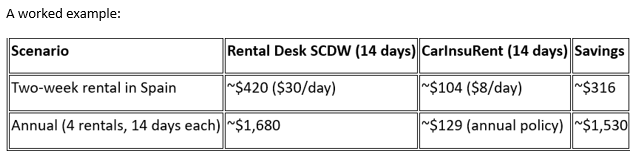
CarInsuRent can sustain lower cost because it focuses on a narrow product (excess reimbursement) rather than full-stack auto coverage, operates with lean digital infrastructure, and pools risk globally. The company offers flexible, customizable insurance plans, with coverage limits adjustable from $2,500 to $4,500 and pricing quoted in euros, pounds, Australian dollars, or US dollars depending on the renter's location.
CarInsuRent emphasizes transparency with no hidden fees. The price shown at quote time is the price charged. There are no add-on surcharges or administrative fees layered in during checkout.
Annual vs Single-Trip Policies: Matching Products to Travel Patterns
CarInsuRent offers two main product formats: single-trip car hire excess insurance tied to a specific rental period, and annual multi-trip policies covering multiple rentals up to 45 days per hire worldwide.
Single-trip policies are ideal for occasional renters taking one holiday road trip per year. They provide coverage for specific rental periods and nothing more. Annual policies cover unlimited rentals for 12 months, making them suited to consultants, digital nomads, expatriates, or frequent travellers who rent cars five or more times per year.
Annual plans offer cost savings for frequent travellers, sometimes reducing per-trip insurance cost by 80% or more compared to buying at the desk each time. They also simplify insurance management for frequent rentals: one purchase per year, one set of policy documents to carry, and one claims portal to use regardless of which rental company or country is involved.
CarInsuRent uses its internal data on rental frequency and average claim amounts to calibrate these offerings. The 45-day-per-rental limit on annual policies aligns with how most international travellers actually rent; few leisure or business trips exceed six weeks.
Digital Claims and Customer Experience: Testing InsurTech Promises
Digital claims are the real test of any InsurTech's value proposition. CarInsuRent offers a straightforward online claims process: the traveler submits a rental agreement, damage report, photos, invoices, and bank details through a web portal. Customers can submit claims online with necessary documentation from anywhere in the world.
The claims process typically aims to reimburse valid claims within five business days. Claims are processed quickly with clear instructions provided at each step. Customer support is readily available for claims assistance via the portal.
Claims processing is simpler and faster with CarInsuRent than with many traditional insurers because of standardized documentation requirements and automation. The company uses digital checks against rental agreements and damage reports to verify claims without requiring in-person inspections.
Friction points remain. Travellers must pay the rental company first and then claim back; this reimbursement model requires upfront cash flow. Obtaining a detailed damage report from certain rental companies can be difficult, especially in countries where counter staff are not accustomed to itemized documentation. CarInsuRent mitigates these issues by publishing step-by-step claim guides and offering support across time zones.
Regional Expansion: Serving Chinese, Australian, and European Travellers
CarInsuRent's digital model allows it to scale into additional regions without building physical networks. Localization efforts focus on payment methods, policy wording compliance, and language support.
For Chinese outbound travellers renting cars in Europe, North America, and Southeast Asia, CarInsuRent supports payment via Alipay, which simplifies both purchase and potential refund flows. Purchasing travel insurance and excess coverage in a familiar payment environment removes one barrier for this fast-growing traveler segment.
Australia presents a distinct market. Self-drive holidays are common domestically and abroad. Regulatory attention increasingly focuses on transparent disclosure of rental company insurance add-ons. CarInsuRent's worldwide annual cover for Australians, with its 45-day-per-rental limit, aligns with typical trip durations in that market.
Europe and the UK remain mature but friction-ridden. Renters face persistent confusion about CDW, Super CDW, and excesses. Terminology varies by country and rental company. CarInsuRent positions itself as a pan-European solution with fixed, published policy documents that clearly state what is and is not covered.
In Latin America, where rental vehicle insurance infrastructure is less standardized, the global presence of a digital-first provider offers travellers a known quantity they can arrange before arrival.
How Global InsurTech Expansion Could Reshape Travel Risk in the Next Decade
Connected vehicles and telematics could change rental car risk management by 2030. Automated detection of collision damage, recorded mileage, and driving behavior data may feed directly into claims verification. CarInsuRent and similar InsurTechs could integrate vehicle data to refine deductible options, reduce disputes, and accelerate reimbursements. Hertz has already piloted AI-based damage detection at vehicle return, pointing toward a future where artificial intelligence handles initial damage assessment.
Emerging mobility patterns create new insurance demand. EV rentals introduce battery damage risk. Peer-to-peer car-sharing platforms like Turo create liability questions that do not fit traditional rental frameworks. Subscription vehicles blur the line between ownership and rental. Each model requires tailored excess insurance products.
Challenges persist: regulatory fragmentation across jurisdictions, data privacy constraints on telematics, and cybersecurity risks affecting online insurance distribution. No single InsurTech will replace traditional insurers or rental companies. CarInsuRent continues to expand as part of a cohort of specialist providers likely to collaborate with larger carriers, travel platforms, and mobility apps rather than displacing them.
For international travellers, the real measure of global InsurTech expansion will be cheaper, clearer, more reliable protection whenever they pick up a rental car abroad. That measure is not about apps or buzzwords. It is about whether the service quality of obtaining coverage, filing a claim, and receiving reimbursement actually improves year over year.
(ADVERTORIAL DISCLAIMER: The above press release has been provided by VMPL. ANI will not be responsible in any way for the content of the same)