The Real Urban Health Crisis May Not Be Immunity. It May Be Recovery
Jun 03, 2026
PNN
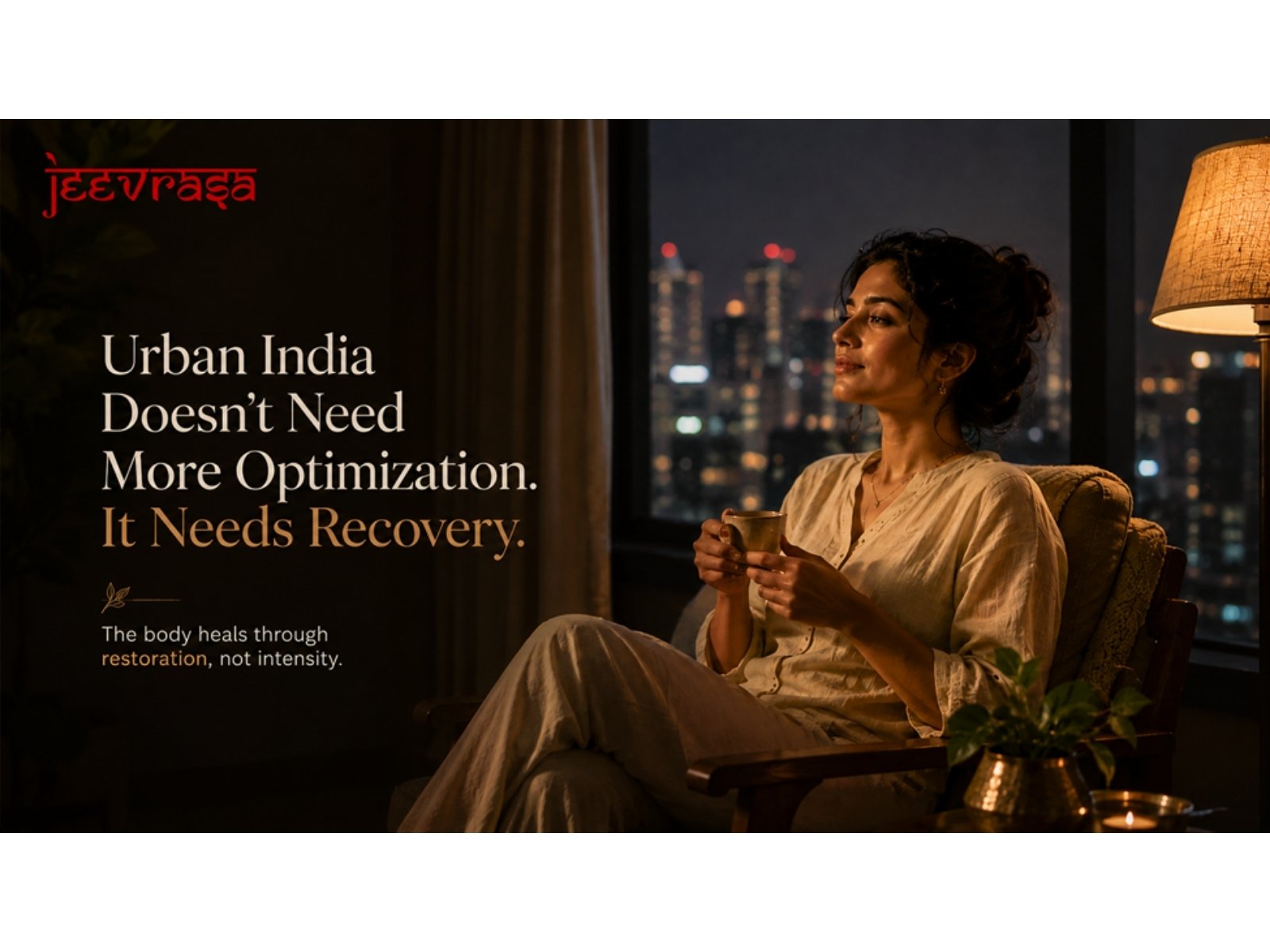
New Delhi [India], June 3: It does not stop people from working. They still attend meetings, meet deadlines, manage households, and move through their days with reasonable competence. But underneath that functioning, something feels progressively harder to maintain.
Waking up unrested after a full night of sleep. Seasonal changes that hit harder than they once did. Stress that lingers in the body rather than clearing. Digestion that feels sluggish without obvious cause. A general sense that the body used to bounce back faster than it does now.
Among urban professionals, particularly those in their late twenties and thirties, this pattern is becoming less of an exception and more of a background condition.
Functioning and recovering are not the same thing
Modern cities are engineered for output. Long work hours, constant connectivity, artificial light, ambient noise, air pollution, irregular eating windows, and the social pressure of always being available all create a continuous load that the body absorbs every single day.
Most people manage to keep functioning under this load. What they report losing, gradually and quietly, is the ability to recover from it.
This distinction matters more than wellness culture currently acknowledges. The absence of illness is not the same as the presence of resilience. A body that is not sick but also cannot restore itself is operating inside a deficit that compounds over time.
Public health researchers studying urban populations in India have noted increasing rates of sleep disturbance, digestive complaint, and stress-related fatigue in age groups that would not historically have been considered high-risk. The clinical markers may not yet be alarming. But the lived experience is widespread enough that it is beginning to reshape what younger consumers actually want from wellness.
Why immunity became the wrong conversation
For most of the last decade, urban wellness in India was organised around a single concept: boost immunity. The pandemic accelerated this. Hundreds of products entered the market promising to strengthen immune response, and consumers bought them in large numbers.
But immunity boosting is a response to the threat of illness. It does not address the underlying question of why the body feels depleted to begin with.
The more fundamental issue, the one that more practitioners are now identifying, is systemic recovery capacity. How efficiently does the body clear accumulated stress? How consistently does it restore energy after demand? How well does it adapt to seasonal, environmental, and lifestyle pressure without degrading?
These questions belong to a different wellness framework than immunity alone.
Classical Ayurveda addressed them through the concept of Bala, the body's foundational strength and adaptive capacity, which is distinct from Vyadhikshamatva, the specific resistance to disease. In Ayurvedic clinical thinking, a person could have reasonable disease resistance but poor Bala, meaning they are rarely seriously ill but never truly restored. This distinction maps closely onto what many urban professionals are currently describing as their experience.
The exhaustion of optimisation
The wellness industry's response to burnout has largely been more wellness. More supplements, more routines, more tracking, more intervention.
For many people, this has created a secondary problem. The pursuit of optimisation has itself become a source of pressure. Health is experienced as another performance metric rather than a natural state.
A shift is underway, quieter than the trends that preceded it. Consumers are beginning to move toward wellness practices that feel sustainable rather than demanding. Less interested in transformation. More interested in stability. Less focused on performance. More focused on basic restoration.
This is partly why traditional systems like Ayurveda are returning to serious wellness conversations, not through nostalgia, but because their structural orientation toward rhythm, seasonal adaptation, and gradual restoration maps onto what people are actually looking for right now.
Formulations built for urban resilience
Some brands are approaching this gap through classical Ayurvedic formulation rather than the supplement model.
JeevRasa, an Ayurvedic wellness brand based in Noida, has developed Rakshaya for urban immunity and environmental resilience, drawing on an eleven-herb classical formulation prepared using the Bhavana process, a traditional method in which herbal powders are repeatedly processed with plant-based liquids across multiple cycles to refine potency and improve absorption. The formulation is positioned around the specific pressures of Indian city life: pollution exposure, seasonal fluctuation, and the cumulative stress load that urban routines create.
The brand's broader positioning reflects the same philosophical reorientation visible across wellness culture: health as a long-term relationship with the body's natural rhythms rather than a series of aggressive interventions.
The question wellness culture has not yet answered well
The most honest observation about urban health right now is not that people are getting sicker in dramatic ways. It is that they are getting less resilient in quiet ones.
Recovery is becoming harder. Restoration is becoming rarer. The baseline of what feels normal keeps shifting downward, and most people are too busy to notice until the gap between functioning and thriving becomes impossible to ignore.
That gap is the actual wellness conversation urban India needs to be having. Not immunity boosting. Not optimization. Not peak performance.
How does the body recover well inside environments that do not slow down? That is a harder question. But it is the right one.
About JeevRasa
JeevRasa is a classical Ayurvedic wellness brand based in Noida, India. Its formulations are prepared using traditional Ayurvedic methods including the Bhavana process and manufactured through a classical Ayurvedic pharmacy. The brand's range includes formulations for immunity, detoxification, and metabolic support, sourced from forest herb regions and formulated without fillers or synthetic additives.
(ADVERTORIAL DISCLAIMER: The above press release has been provided by PNN. ANI will not be responsible in any way for the content of the same.)